Pixma G2260 Honest Review — Is the Hype Justified?
Introduction
I've been using the Canon Pixma G2260 for several months now in my home office and around the house, so I feel ready to write an honest review. The Pixma G-series promises ultra-low running costs thanks to refillable ink tanks, and the G2260 sits near the entry point of that line. When I bought it, I wanted a reliable everyday printer that could handle reports, school projects, and the occasional photo without bleeding my wallet dry on cartridges. What I found was a mix of clear advantages and some compromises you should know before buying.
What I Tested and How
My testing covered about five months of regular use: printing invoices and documents for my freelance work, school worksheets for my kids, and photo prints to hang around the house. I averaged out everyday prints with occasional high-volume runs, and I deliberately monitored ink consumption, paper jams, print quality at different settings, and the unit's maintenance needs. I also installed the printer twice—first on a Windows laptop and later on a small Linux machine—to gauge installation quirks and driver support.
Design and Build
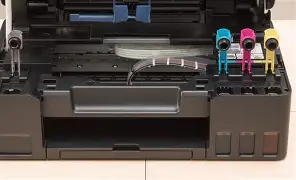
In my experience, the Pixma G2260 is unmistakably utilitarian. It's larger than typical cartridge-based printers because it houses visible ink tanks along the front. I appreciated that—the clear reservoirs make it easy to see ink levels at a glance, and I've never been one for guessing whether the black will run out mid-report. The chassis is mostly hard plastic, and the construction feels adequate for a budget-focused device. I noticed some flex around the output tray and the scanner lid (if you have the model with scanning), so it doesn't feel as premium as more expensive machines.
One design choice that bothered me at first was the footprint. The tanks sit in front, which means the printer needs a bit more desk depth. I had to rearrange my workspace to accommodate it. On the upside, the refill bottles lock into the tanks cleanly—after a couple of refills I developed a little routine and rarely made a mess.
Setup and Installation
Setting up the Pixma G2260 was straightforward for basic USB printing. The included quick-start guide was concise and helped me through the initial ink priming and alignment. I did have to be patient during the first ink charging cycle—Canon's priming process takes some time and prints a few waste pages to saturate the head and feed lines. That felt wasteful at the moment, but it's a common step for refillable systems.
Driver support worked fine on my Windows laptop; the bundled driver installer found the printer and installed the necessary utilities. On my Linux box, I had to search a bit for compatible drivers, and while it worked with generic drivers, I missed a couple of Canon utilities like ink level reporting. If you rely on out-of-the-box Wi‑Fi setup or cloud printing features, check closely—my unit didn't offer an easy wireless setup and connected over USB only. That may be different in other regional variants, but in my experience the G2260 was a wired-first machine.
Print Quality
Text and Documents
What I relied on the Pixma G2260 most for was text. In my experience, the printer produces sharp, dark black text that's perfectly acceptable for reports, invoices, and schoolwork. The black ink is rich enough that I rarely had trouble with faint characters or streaks—except after long idle periods when the first page out could be slightly faded until the printhead warmed up.
Photos and Color Prints
For photos, I had mixed feelings. Casual 4x6 prints looked good for displaying on my refrigerator or framing for a quick project. Skin tones were generally pleasing, and colors had reasonable saturation. However, when I compared prints to those from a dedicated photo lab or a higher-end photo inkjet, the G2260's output lacked subtle gradation and deep contrast. Color accuracy wasn't terrible, but if you want museum-quality photo prints, this isn't the machine for you. I was surprised at how well it handled glossy photo paper at draft settings, but at higher quality settings print times lengthened quite a bit.
Find top-rated Electronics products at great prices.
Shop Amazon →Color Consistency and Smudging
I noticed occasional smudging when I handled prints immediately after printing on thicker glossy stock. Letting prints dry briefly solved the issue. Over months of use, I also saw slight banding in large solid color areas on a few print jobs—something I remedied with a printhead alignment and a head-cleaning cycle. The cleaning cycles do use some ink, so that's a trade-off.
Speed and Performance
Speed-wise, the G2260 is not a racecar, but it's competent for home and small office tasks. Everyday draft prints came out quickly, and single-page black documents were ready almost immediately. For high-resolution color prints and photos, expect to wait longer—several minutes for high-quality 4x6 or A4 photo prints. I found batching jobs helped: queue up a set of documents, walk away, and come back to a stack of cleanly printed pages.
I experienced very few paper jams. On the handful that did occur, they were mainly caused by thicker paper or manual duplexing errors. The paper feed works best with standard office-weight paper; for anything heavier, take care to feed one sheet at a time.
Ink, Running Costs, and Refill Experience
The key selling point of the G2260 is the refillable ink tanks. In my use, the real advantage showed up over time. After several months, I had only refilled the black bottle once despite steady document printing, which translated into noticeable savings compared to cartridge replacements I've bought for past printers.
Buying bottles and refilling is straightforward. Canon's bottles are designed to click into place and minimize spills. I still keep a cloth handy for the first few refills until you get used to the twist-and-press motion. I also kept detailed notes on ink usage: heavy photo printing eats through the color bottles faster than documents, but overall, my per-page cost dropped considerably. If you print many black-and-white pages, the system is particularly economical.
One thing I was mindful of: refillable systems tend to lead to occasional maintenance. When swapping ink for extended storage (I had a two-week vacation), I ran a cleaning cycle when I returned to maintain nozzles. I wouldn't call this frequent, but it's something to budget time for if you print intermittently.
Maintenance and Reliability
Over the months I've used it, the Pixma G2260 has been stable. I had to run the printer's automatic head cleaning a few times, especially after long idle periods. Those cleaning cycles are quick but consume some ink. The maintenance page in the printer utility helps track head usage and alignment, which I found useful after a print job with slight banding.
Find top-rated Electronics products at great prices.
Shop Amazon →Build longevity: the exterior plastics began to show minor scuffs after moving the printer a couple of times, but the internal mechanics remained dependable. I did have one instance where the printer failed to wake from sleep properly and required a power cycle; this happened once in several months and could be a one-off firmware hiccup.
Pros & Cons
- Pros:
- Low running costs thanks to refillable ink tanks — excellent for high-volume black-and-white printing
- Very good black text quality; reliable for everyday documents
- Visible ink tanks make level monitoring easy
- Simple, no-nonsense setup and operation for wired connections
- Cons:
- Bulky footprint due to front-facing ink tanks — needs desk space
- Photo quality is adequate but not professional-grade
- Noisy at times during high-quality color prints and cleaning cycles
- Limited connectivity in my unit (USB only) — no easy wireless printing out of the box
- Periodic head cleaning consumes ink and can be inconvenient
Comparison: Pixma G2260 vs Alternatives
| Feature | Pixma G2260 (my experience) | Epson EcoTank-style (typical) | Higher-end Photo Inkjet (typical) |
|---|---|---|---|
| Running Cost | Low — refillable tanks, great for text-heavy use | Low — similar refillable system, often with Wi‑Fi | Higher — cartridges, more expensive per page |
| Text Quality | Excellent for documents | Very good | Excellent |
| Photo Quality | Good for casual photos, not professional | Good to very good depending on model | Excellent — better color depth and gradation |
| Connectivity | USB/wired in my unit | Often includes Wi‑Fi and mobile printing | Usually Wi‑Fi + advanced color management |
| Maintenance | Occasional head cleaning, refill care | Similar maintenance, generally user-friendly | More frequent alignment/maintenance for perfect photos |
| Best for | Home office and document-heavy households | Users wanting low costs + wireless convenience | Photography enthusiasts and pros |
Buying Guide — Is the Pixma G2260 Right for You?
Who should consider the G2260?
If you print a lot of documents and are tired of replacing cartridges, the G2260 makes sense. In my experience, its running cost advantage becomes clear after a few months of regular printing. It's particularly suitable for:
- Home offices or small businesses that primarily print text
- Families with school-age children who print worksheets and projects regularly
- Anyone wanting simple refillable ink convenience without cartridge changes
Who should look elsewhere?
Buyers who need excellent photo prints or robust wireless features out of the box may prefer other models. In my experience, if you regularly print high-quality photos or require cloud printing and direct mobile print without a host computer, a higher-end photo inkjet or a different EcoTank/Epson model with strong wireless support might be a better fit.
Key buying questions to ask yourself
- How many pages do I print per month? If you print hundreds, the refillable tanks will likely save you money quickly.
- Do I need wireless printing or mobile printing from phones/tablets? Check the model variant carefully; some regional versions have Wi‑Fi while others are USB-only.
- Will I print photos often? If photo quality is a priority, compare sample prints before deciding.
- Do I want an all-in-one (scan/copy) or a printer-only device? Confirm the exact feature set for the SKU you're buying.
- Am I comfortable performing basic maintenance like head cleaning and manual refills? These are straightforward but part of ownership.
Practical tips if you buy one
- Keep a rag or paper towel handy for the first few refills—accidents are rare but possible until you get the hang of it.
- Position the printer where you can comfortably see the ink tanks; that transparency is one of the model's best features.
- Run a head alignment after your first full bottle refill to reduce banding and maintain crisp prints.
- If you go on vacation, print a nozzle check before leaving and run a cleaning cycle on return to avoid dry heads.
- Use recommended paper types for photos to minimize smudging and improve color rendition.
Conclusion
After using the Pixma G2260 for several months, I can say the hype has merit—particularly if your priority is low running costs for regular document printing. In my experience, the refillable tanks are the standout feature: they're practical, economical, and remove the frequent cartridge replacement chore. The G2260 delivered excellent text quality and reasonable color prints for casual photo use. However, the printer is not perfect. The lack of advanced wireless features in my unit, the bulkier footprint, and the occasional need for head cleaning are real trade-offs.
Ultimately, if you want a straightforward, economical printer for everyday documents and occasional photos and are comfortable with manual ink refills and basic maintenance, I found the Pixma G2260 to be a strong value. If you need professional photo quality, automatic duplexing, or seamless mobile/cloud printing, you might want to consider other models that prioritize those features. For my home office needs, the G2260 has been a dependable, cost-saving workhorse—one that I would recommend to friends with similar priorities.