Biggest Mx Mechanical Buying Mistakes (And How to Avoid Them)
The Mx Mechanical line of keyboards occupies a distinct place in the market: a premium, low‑profile mechanical keyboard designed for professionals who split time between typing, creative work, and multi‑device workflows. With a thoughtful blend of wireless connectivity, refined key action, and a minimalist aluminum finish, the Mx Mechanical attracts buyers who want mechanical feel without the bulk of a traditional board. Yet several common mistakes systematically reduce satisfaction after purchase. This article identifies the biggest buying errors people make when buying an Mx Mechanical keyboard and offers practical guidance to avoid them. It also includes a detailed product analysis, pros & cons, a focused comparison to related options, a buying guide, and a concluding evaluation grounded in real‑world use cases.
Introduction: Why buyers stumble
Buyers often arrive at the Mx Mechanical decision already convinced that mechanical = better. That assumption, combined with the keyboard's premium pricing and marketing that emphasizes versatility, leads to several predictable missteps: selecting the wrong layout, underestimating switch feel differences, overlooking platform compatibility, or expecting enthusiast‑level customization (hot‑swap, full macro ecosystems) that the Mx Mechanical purposely deprioritizes. These mistakes are not unique to this model, but they matter here because the keyboard targets professionals who rely on predictable, long‑term performance.
Detailed product review and analysis
The Mx Mechanical is best understood as a premium, low‑profile mechanical keyboard engineered for productivity. Key highlights include a slim aluminum or metal top plate, low‑profile mechanical switches, multi‑device pairing, and smart backlighting. The keyboard's design language favors a flat, office‑friendly aesthetic over loud gamer styling. That informs the hardware and software choices—stability, battery life, and cross‑platform shortcuts are emphasized over flashy RGB and radical macro engines.
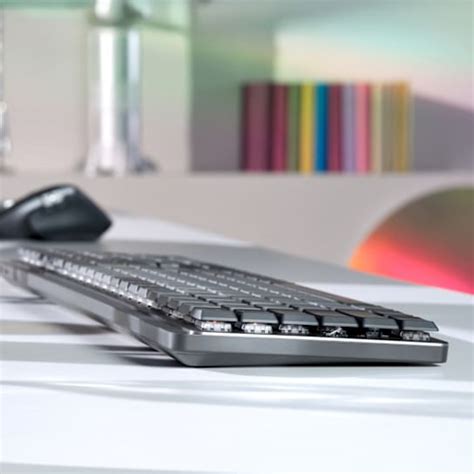
Typing feel and switches: The Mx Mechanical uses low‑profile mechanical switch technology designed to reduce key travel and create a more laptop‑adjacent profile. These switches deliver a crisper, faster actuation than scissor‑switch laptop keys while preserving a calmer acoustic signature compared with taller mechanical switches. Two broad switch families are typically offered: tactile (for typing feedback) and linear (for a smoother stroke). This choice is decisive: tactile switches reward typists who rely on feedback for accuracy, while linear switches can feel faster for editors and some gamers.
Connectivity and multi‑device workflows: One of the keyboard's strengths is reliable multi‑device support. It commonly supports simultaneous pairing to multiple devices and quick switching between them using dedicated function keys. Connection methods usually include Bluetooth and a proprietary wireless receiver option (often optimized for reliability and lower latency). In real‑world setups—developers switching between a work laptop and a home desktop, or content creators toggling between a desktop and a tablet—the keyboard's multi‑host capability reduces friction and saves time.
Backlighting and smart illumination: The backlighting is practical rather than decorative. Adjustable brightness levels and a proximity/light sensor that wakes the backlight when hands approach are common features. This conserves battery while offering convenience for low‑light typing sessions.
Build quality and ergonomics: The Mx Mechanical typically has a solid build with a metal top case and elevated stability. The low profile reduces wrist extension compared with tall mechanical keycaps; however, the flat orientation means some users may prefer an external wrist rest or a slight typing tilt. The keyboard includes adjustable feet for angle, and keycaps are often contoured to reduce finger travel despite the short profile.
Software and customization: The manufacturer provides configuration software for remapping keys, setting function behaviors, and performing firmware updates. While the software supports productivity‑oriented macros and device profiles, it is not as open or deep as enthusiast firmware that supports per‑key RGB or hot‑swapping. Buyers seeking full customizability in switches or keycaps will find limits here.
Real‑world use cases
- Programmers and writers: Benefit from the tactile switch option and stable Bluetooth connections for alternating between a laptop and desktop.
- Office professionals: Appreciate quiet operation, smart backlighting for dim conference rooms, and the professional aesthetic an aluminum chassis offers.
- Creative professionals: Use multi‑device pairing to jump between a primary workstation and a tablet for reference, while relying on consistent key feel for extended editing sessions.
- Hybrid workers and commuters: Value the low profile and relatively light footprint—combined with wireless modes—for packing into a bag, though full portability requires attention to model size (full‑size vs compact).
- Casual gamers: Can enjoy fast actuation and low travel, though competitive players who demand ultra‑low latency and specialized gaming features may prefer gaming‑focused boards.
Pros & Cons
Pros
- Refined low‑profile mechanical feel: Faster key action and a quieter acoustic signature than traditional tall switches, while retaining satisfying feedback.
- Premium build and finish: Metal top case and stable construction suitable for office and home office aesthetics.
- Reliable multi‑device connectivity: Seamless switching between multiple paired devices simplifies mixed‑device workflows.
- Smart, practical lighting: Intelligent backlighting balances usability and battery conservation.
- Cross‑platform support: Includes key legend sets and software support for both Windows and macOS layouts (often available as model variants).
Cons
- Premium price tier: Higher cost compared with many mainstream keyboards—expect to pay for design and convenience.
- Limited enthusiast customization: No hot‑swap sockets and restricted aftermarket keycap compatibility for low‑profile switches.
- Switch choice is limited: Choice often limited to tactile or linear low‑profile variants; specialty switch fans may feel constrained.
- Not optimized for hardcore gaming: While competent, it omits competitive gaming features like per‑key macros and extreme polling rate customization.
- Ergonomic nuance: Low profile is not a universal ergonomic solution—some users will still need a wrist rest or different tilt to avoid strain.
Comparison
| Feature | Mx Mechanical | Traditional Full‑Height Mechanical | Low‑Profile Scissor/Chiclet (laptop style) |
|---|---|---|---|
| Key Profile | Low‑profile mechanical switches | Taller mechanical switches (Cherry, Gateron, etc.) | Very low travel, scissor switches |
| Typing Speed & Feedback | Fast, crisp; good tactile options | Varied—strong tactile/linear options | Smoother but less tactile feedback |
| Portability | Relatively portable for a mechanical keyboard | Less portable—bulkier and heavier | Most portable and lightest |
| Customization | Software remaps; limited hardware mods | Highly customizable (hot‑swap, keycap swaps, firmware) | Minimal customization options |
| Battery / Wireless | Multi‑device wireless; long battery life | Often wired or basic wireless; variable battery life | Mostly Bluetooth; good battery life |
| Target User | Professionals, writers, developers | Enthusiasts, gamers, typists seeking customization | Casual users, frequent travelers |
Biggest buying mistakes and how to avoid them
This section addresses the most frequent missteps with actionable alternatives.
Find top-rated Electronics products at great prices.
View Offers →Mistake 1: Buying the wrong layout
Many buyers assume “one size fits all” and buy a full‑size Mx Mechanical without considering desk space, numpad needs, or portability. The wrong layout undermines the purchase quickly—num pad users may love full‑size, while cramped desks or frequent travelers may regret it.
How to avoid it: Identify daily tasks that require a numpad (data entry, finance). If the numpad is rarely used, a TKL or compact option preserves desk space and ergonomics. For frequent travel, prioritize compact versions and protective cases.
Mistake 2: Choosing the wrong switch type
Switch feel is subjective. Some buyers expect a tall mechanical sensation and are disappointed by low‑profile switches; others expect laptop‑like softness and find mechanical feedback jarring.
How to avoid it: Test both tactile and linear low‑profile switches in person if possible. If a physical test is not feasible, watch objective sound and travel demos and read multiple hands‑on reviews focused on typing tests rather than marketing copy.
Mistake 3: Expecting enthusiast modifications
Some buyers expect to swap switches, install custom keycaps, or use advanced community firmware. The Mx Mechanical emphasizes out‑of‑the‑box convenience, not hobbyist modification.
How to avoid it: If customization is a priority—hot‑swap PCB, custom keycaps, or firmware projects—consider enthusiast models explicitly designed for modding. If the priority is a reliable, low‑maintenance keyboard, the Mx Mechanical remains a strong choice.
Mistake 4: Overlooking platform compatibility
Logos, modifier key legends, and default function behaviors differ between Windows and macOS. Purchasing a Windows‑oriented model for a Mac workflow can create friction (wrong option labels, swapped keys).
How to avoid it: Determine whether a Mac‑specific variant or configurable software profile is needed. Confirm that the manufacturer provides macOS‑friendly key maps and that the software supports macOS for remapping and firmware updates.
Mistake 5: Ignoring ergonomics and daily setup
The low profile reduces wrist extension but does not guarantee ergonomic comfort. Buyers assuming the keyboard alone will fix typing strain may be disappointed.
Discover deals on Electronics — updated daily.
See Deals →How to avoid it: Consider desk height, chair position, and wrist support. Add a wrist rest if necessary. Test typing angle and use adjustable feet to fine‑tune posture before concluding the keyboard is at fault for discomfort.
Mistake 6: Misreading battery expectations
Battery life claims often depend on backlighting and frequency of device switching. Buyers drawn to multi‑device features may underestimate how much power those radios draw.
How to avoid it: Look for realistic battery estimates under usage scenarios (backlight on vs off, Bluetooth vs proprietary receiver). If long battery life is critical, prioritize conservative battery estimates or plan to keep the receiver connected when possible.
Buying guide: What to check before purchasing
Follow this checklist to match the Mx Mechanical to real needs.
- Define primary use: Is the keyboard for heavy typing, coding, creative work, gaming, or travel? Each use case prioritizes different attributes (switch feel, layout, latency).
- Choose the right layout: List whether a numpad is required or whether space and portability are more important.
- Decide switch family: Prefer tactile for feedback and accuracy; choose linear for smooth strokes. If unsure, test in store or seek comparison videos with measured key travel and actuation.
- Confirm platform support: Verify macOS/Windows key legends and that the configuration software supports the primary OS for remaps and firmware updates.
- Check connectivity options: Ensure the keyboard includes the preferred pairing method (Bluetooth, USB receiver) and supports the desired number of simultaneous hosts.
- Assess battery claims: Look for realistic scenarios and check whether there's a fast‑charging option or an easy wired mode for extended sessions.
- Evaluate customization needs: If hot‑swap and keycap modding matter, choose an alternative designed for those features. If not, prioritize out‑of‑the‑box ergonomics and software integration.
- Test acoustics: Acoustic profile matters for shared workspaces—listen to sample recordings or test in person for acceptable noise levels.
- Warranty and support: Confirm the warranty period and availability of firmware updates—long‑lived software support matters for a long‑term desk staple.
Price‑vs‑value considerations
The Mx Mechanical lands in a premium segment where price often reflects design, materials, and integration with a broader productivity ecosystem. Buyers should ask: Is the design aesthetic and multi‑device convenience worth the extra cost over mid‑tier options? For many professionals who spend several hours a day typing, the improved ergonomics, stable wireless experience, and build quality justify the premium. For hobbyists who prioritize mechanical customization, the extra spend may not align with personal goals.
Maintenance and long‑term ownership tips
- Firmware updates: Keep firmware and companion software current to maintain device compatibility and security.
- Cleaning: Use compressed air and a soft cloth; low‑profile keycaps discourage dust buildup compared with taller profiles, but spills still require prompt attention.
- Battery care: Avoid leaving the keyboard depleted for extended periods. If unused for a long time, store partially charged and update firmware before first use after storage.
- Accessory pairing: Consider a discreet wrist rest and non‑slip desk mat to refine ergonomics and protect surfaces.
Conclusion
The Mx Mechanical is a compelling choice for professionals who want the confident feedback of mechanical switches combined with a low‑profile, office‑friendly form factor and robust multi‑device support. The most common buying mistakes stem from mismatched expectations: layout, switch feel, customization needs, and platform compatibility. Avoiding these pitfalls requires honest assessment of daily workflows, a realistic understanding of the keyboard's strengths and constraints, and—where feasible—hands‑on testing.
When matched to the right user—programmers, writers, hybrid workers, and creative professionals who value quiet, efficient typing and seamless device switching—the Mx Mechanical delivers a durable, refined experience. For those who prioritize deep hardware modability, extreme gaming features, or interchangeable switches, a different class of keyboard better fits those needs. By following the buying checklist and thinking through the practical use cases described above, buyers can make an informed decision and avoid the common mistakes that lead to regret after purchase.